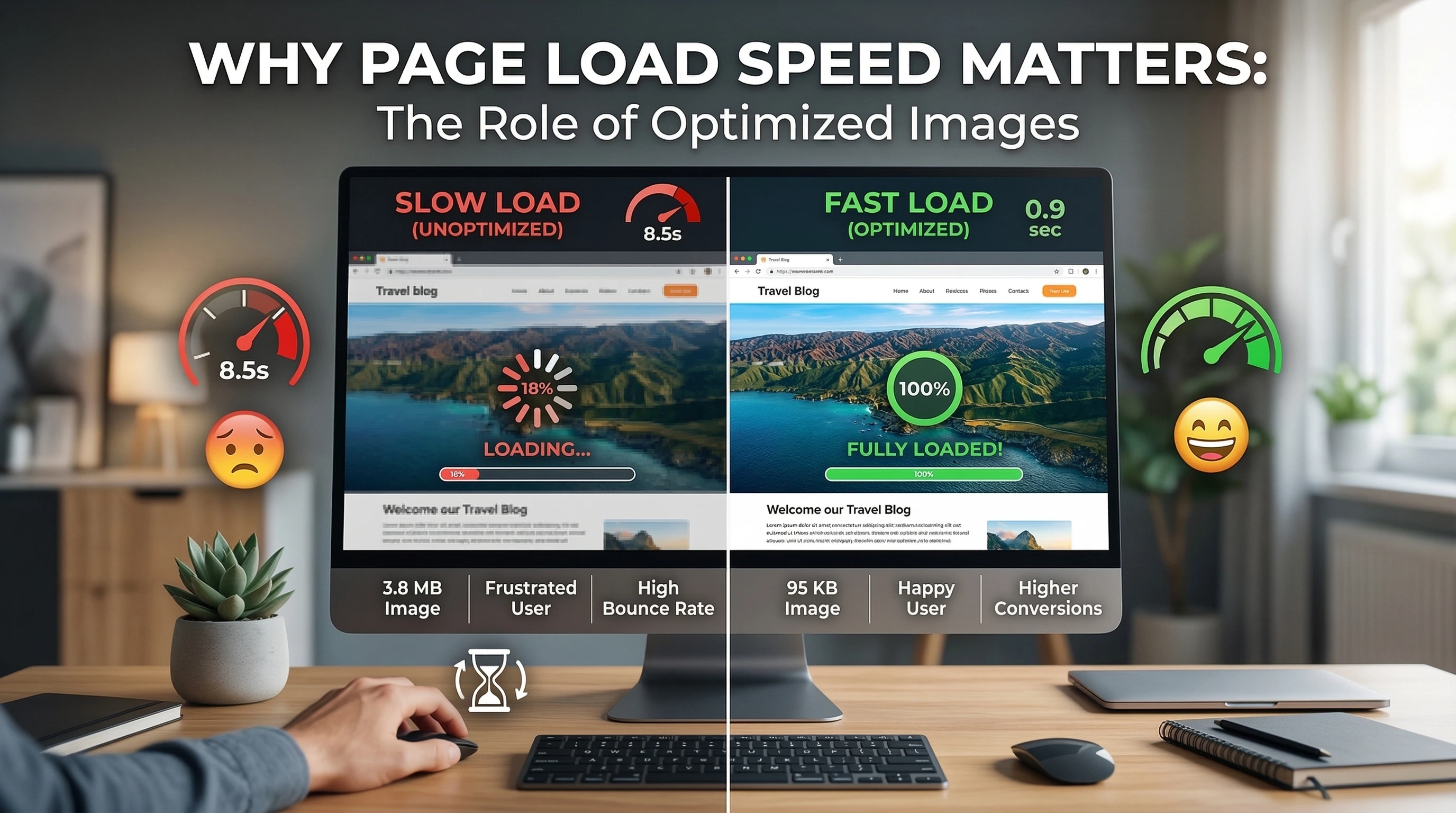
Ever landed on a website that feels like it's loading in slow motion? You wait... and wait... while a beautiful hero image trickles in pixel by pixel. Frustrating, right? In 2026, with everyone glued to their phones and expecting instant gratification, that sluggish experience isn't just annoying—it's expensive. Page load speed directly influences whether visitors stick around, convert, or bounce straight back to Google. And guess what? Images remain one of the biggest bandwidth hogs, often accounting for over half of a page's total weight.
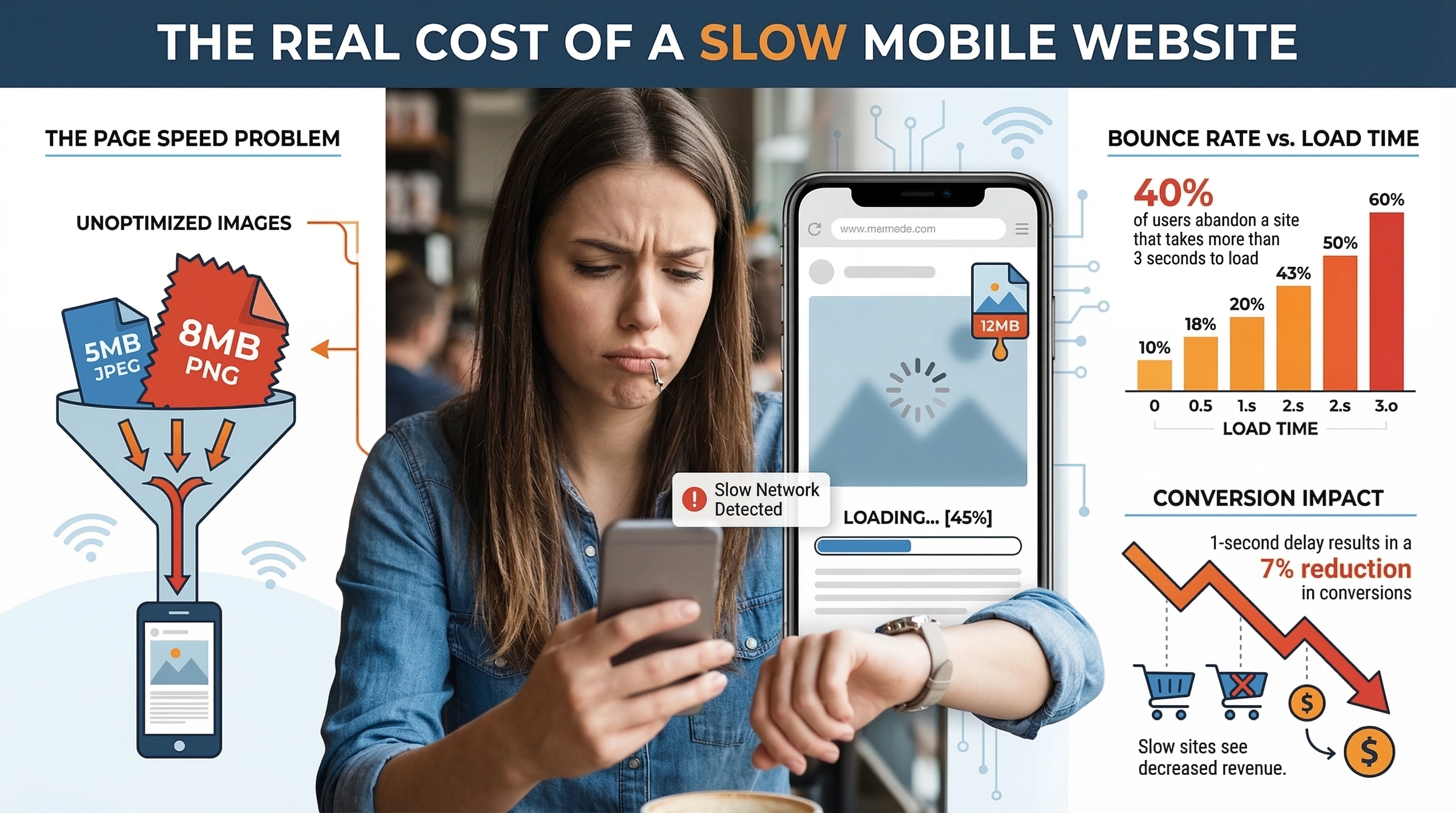
Recent stats paint a clear picture: a mere one-second delay can slash conversions by up to 7%, while pages taking longer than three seconds see bounce rates skyrocket by 32%. On mobile, where most traffic comes from, users are even less patient—53% abandon sites that drag beyond three seconds. Google hasn't let up either. Core Web Vitals, especially Largest Contentful Paint (LCP), stay front and center for rankings and user experience signals. If your main content (frequently a big image) takes over 2.5 seconds to appear, you're hurting your site's visibility in search results and Discover feeds.
But here's the good news: optimizing images delivers some of the quickest, highest-impact wins for page speed optimization. By compressing files, switching to efficient formats like WebP or AVIF, and implementing smart techniques such as lazy loading, you can cut load times dramatically—sometimes by 30-70%—without sacrificing visual appeal. This boosts engagement, lowers bounce rates, trims hosting costs through reduced bandwidth, and strengthens your SEO foundation.
In this in-depth guide, we'll break down exactly why images slow down website performance, the real-world unoptimized images page speed impact, and proven strategies to optimize images to speed up the site. You'll walk away with actionable, fast-loading images SEO tips tailored for 2026, including how WebP images faster page load and compress images for better SEO play out today. Let's dive in and turn your site into a speed demon.
Why Images Are the Top Culprit Behind Slow Websites
Images bring pages to life—product shots, infographics, stunning photography—but they also pack the heaviest punch when it comes to file size. Without optimization, a single high-resolution photo from your smartphone can weigh 3-5MB. Multiply that by a dozen on a homepage, and you're looking at tens of megabytes just for visuals.
In 2026, average page weights hover around 2-3MB, yet unoptimized media-heavy sites easily balloon to 5MB+. On slower connections (still common in many regions), this translates to 5-10+ second loads. Users won't wait: 39% close tabs if images lag too long. The result? Higher bounce rates, lost sales, and weaker engagement metrics that Google notices.
Breaking Down the Unoptimized Images Page Speed Impact
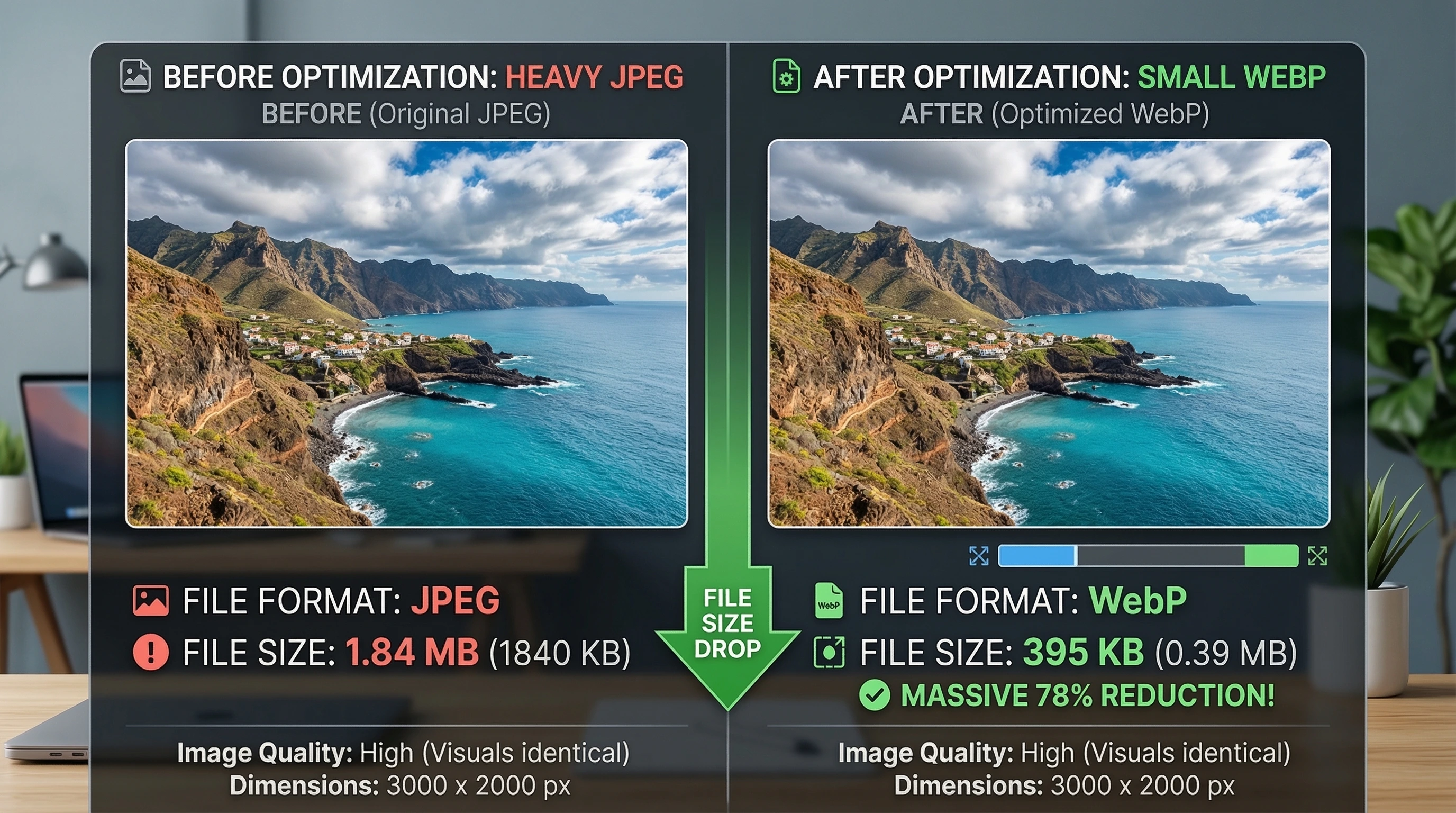
Unoptimized images page speed impact ripples through every key metric. They inflate Largest Contentful Paint (LCP), the time until your main content renders—Google flags anything over 2.5 seconds as needing improvement. They also trigger Cumulative Layout Shift (CLS) when dimensions aren't specified, causing annoying jumps as images pop in.
From a business angle, the damage compounds. Retail sites lose billions annually to slow loads, with each extra second potentially cutting conversions by 7-20%. Mobile users, who dominate traffic, face data charges and frustration, leading to cart abandonment. In search, poor vitals weaken rankings, especially as Google ties page experience more tightly to AI-driven features.
(Example of a bloated vs. optimized image comparison—notice the file size drop from 4MB to under 200KB while keeping sharpness.)
Core Web Vitals in 2026: Why Speed Still Rules Rankings
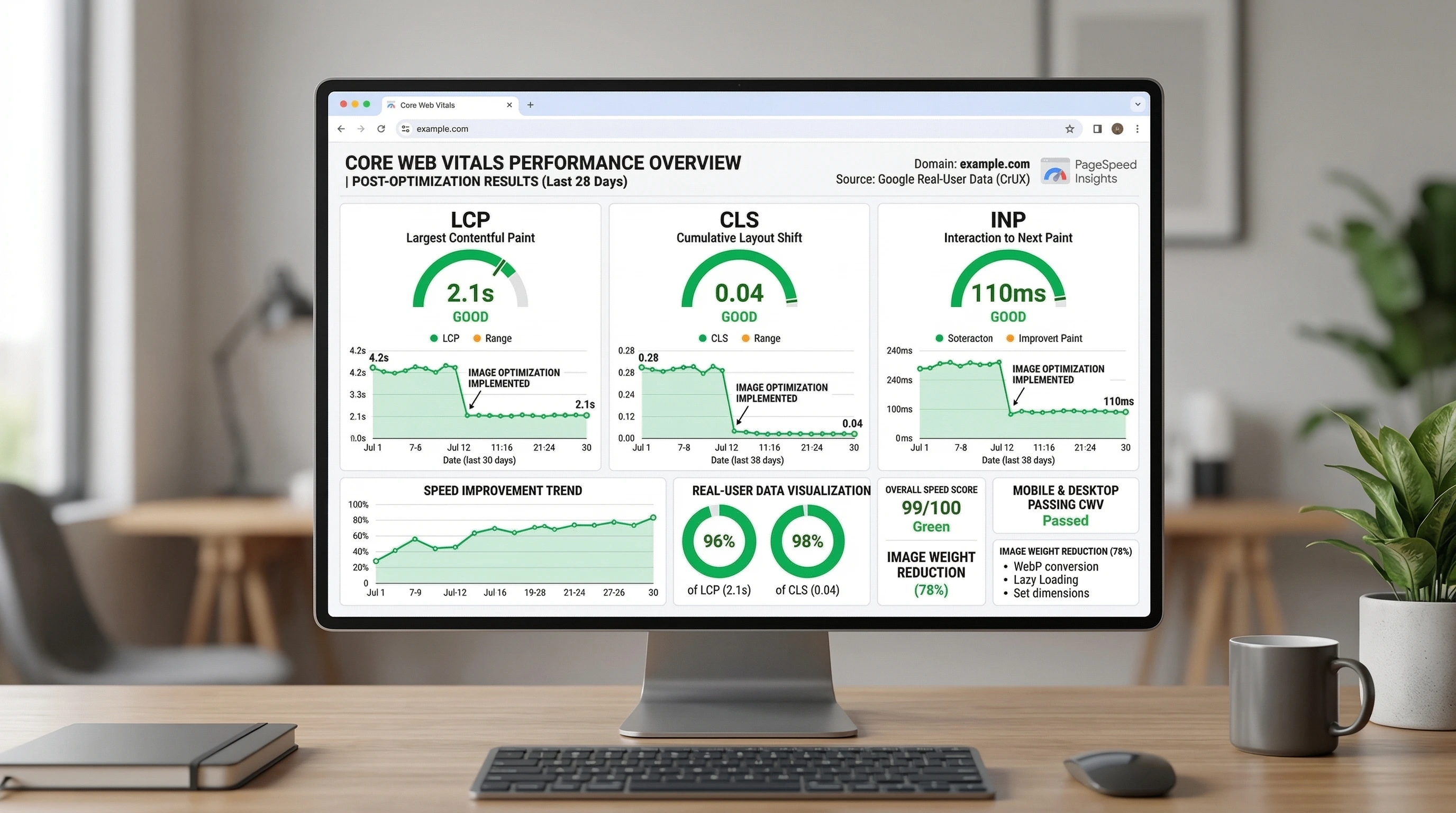
Core Web Vitals haven't gone anywhere in 2026—they're more important than ever for SEO and user satisfaction. LCP measures real loading speed, Interaction to Next Paint (INP) tracks responsiveness, and CLS ensures visual stability. Images heavily influence LCP and CLS.
Google's tools like PageSpeed Insights now blend lab data (simulated tests) with field data (real Chrome users), giving accurate insights. Sites passing vitals thresholds earn better visibility in search and Discover. Fail them? Expect lower rankings and fewer impressions.
How to Optimize Images to Speed Up Your Site Step-by-Step
Ready to fix it? Start with an audit using free tools like Google PageSpeed Insights. It highlights oversized images and suggests fixes.
- Resize images to match display dimensions—don't upload 4000px-wide files for 800px slots.
- Compress aggressively but smartly—lossy for photos, lossless for graphics.
- Choose modern formats like WebP or AVIF.
- Implement lazy loading and responsive techniques.
These steps alone can halve page weight.
Picking the Best Image Format: WebP, AVIF, and Beyond in 2026
Format choice makes a massive difference. JPEGs work for photos but waste space. PNGs handle transparency but bloat files.
WebP images faster page load remains a top choice—offering 25-35% smaller sizes than JPEG with solid quality. Browser support hits near 97% across Chrome, Firefox, Edge, and Safari.
AVIF edges ahead in compression (up to 50% better), plus HDR support, but sits at 93-95% coverage. Use picture elements with fallbacks:
<picture>
  <source srcset="image.avif" type="image/avif">
  <source srcset="image.webp" type="image/webp">
  <img src="image.jpg" alt="Optimized product photo">
</picture>
This ensures broad compatibility while prioritizing speed.
Compress Images for Better SEO: Tools and Techniques That Work
Compress images for better SEO by reducing file sizes without visible quality loss. Aim for 70-85% quality on lossy compression—tools like TinyPNG or ShortPixel handle this effortlessly.
In 2026, top performers include Cloudinary, ImageKit, and imgix for automated optimization via CDN. For WordPress, plugins like ShortPixel, Imagify, or WP-Optimize deliver bulk compression plus WebP conversion. Smaller files mean faster LCP, better vitals, and stronger crawl efficiency—direct SEO wins.
(Before-and-after compression: same scene, file size slashed dramatically.)
Lazy Loading Images Page Speed: The Low-Effort Power Move
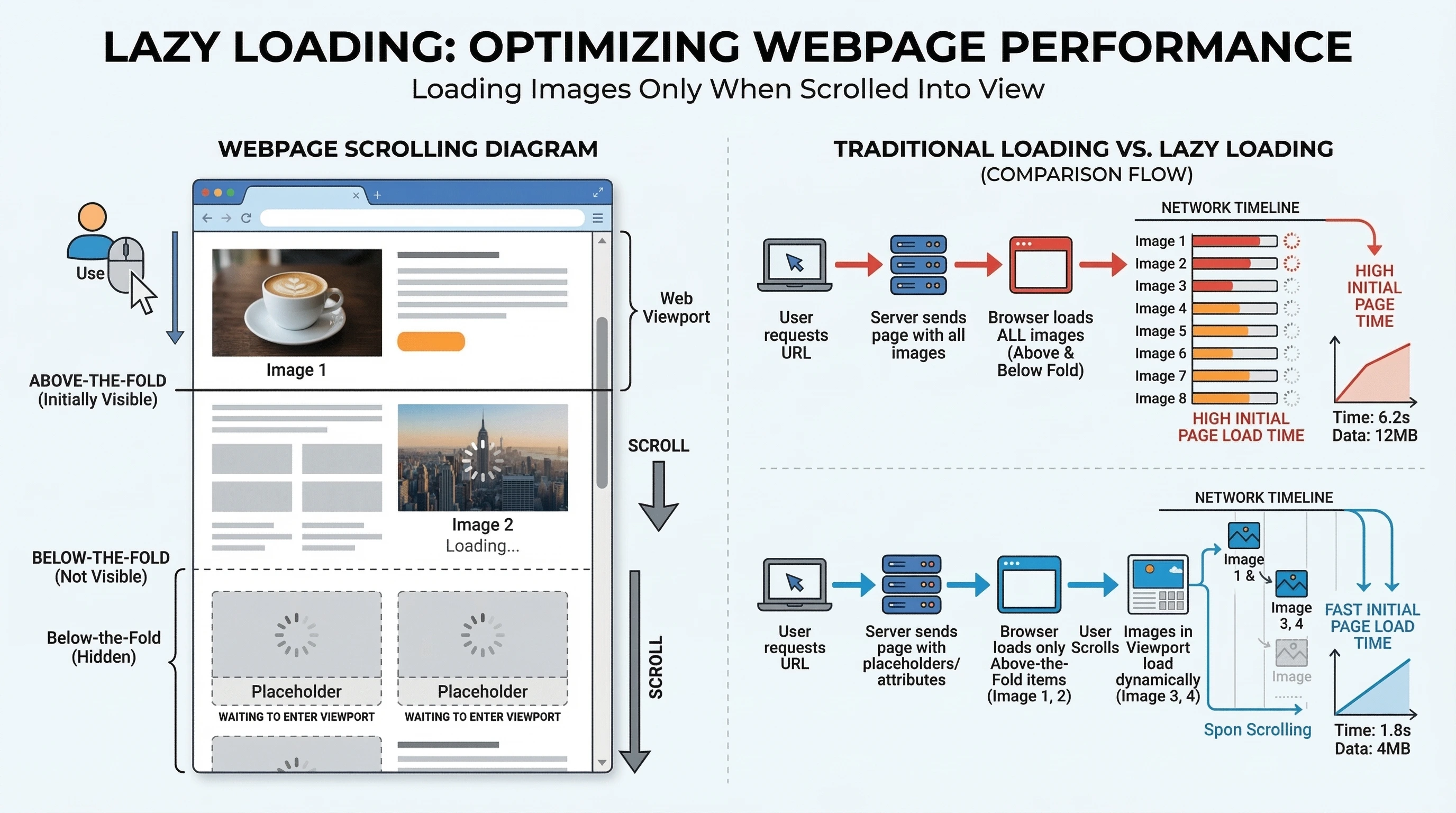
Lazy loading images page speed defers off-screen images until users approach them—cutting initial load by 30-70%. Simply add loading="lazy" to <img> tags.
Avoid lazy-loading above-the-fold heroes (they hurt LCP). Modern browsers handle this natively, but plugins ensure fallback support. Pair with preloading critical images via <link rel="preload"> for the best balance.
Fast Loading Images SEO Tips to Outrank Competitors
Want fast-loading images and SEO tips that stick in 2026?
- Use descriptive, keyword-rich alt text: "red running shoes on forest trail" beats "IMG_5678".
- Name files meaningfully: "fast-loading-red-shoes.webp".
- Serve responsive images with srcset for device-specific sizes.
- Leverage CDNs like Cloudflare or Bunny.net to deliver from edge servers.
- Add structured data (ImageObject schema) for rich results.
These tweaks improve accessibility, crawlability, and visual search potential.
Page Speed Optimization Images 2026: Emerging Trends and Tools
Looking at page speed optimization images 2026, AI-powered tools auto-optimize on upload, predictively load content, and even generate variants. CDNs with image processing (like ImageKit or Cloudinary) serve format-converted, resized versions dynamically.
Monitor with Google Search Console for vitals trends and GTmetrix for detailed waterfalls. Audit quarterly—trends evolve fast.
Responsive Images and CDNs: Advanced Speed Boosters
Go further with responsive images:
<img srcset="small.webp 480w, medium.webp 800w, large.webp 1200w"
     sizes="(max-width: 600px) 480px, 800px"
     src="medium.webp" alt="Responsive example">
Combine with a CDN to minimize latency. Global delivery shaves seconds off loads, especially for international audiences.
Avoiding Common Image Optimization Mistakes
Don't over-compress—artifacts ruin trust. Skip lazy loading on LCP elements. Forget alt text? Accessibility and SEO suffer. Always test on real devices and connections.
Tracking Your Wins: Essential Tools for Measurement
Use Google PageSpeed Insights for scores and suggestions. Check real-user data in Search Console. Tools like WebPageTest offer filmstrips to visualize improvements.
Watch bounce rates drop, session duration rise, and conversions climb as proof.
In the end, page load speed isn't a nice-to-have—it's make-or-break in 2026. Images drive visuals but can cripple performance if ignored. By tackling why images slow down website issues head-on—through compression, modern formats, lazy loading, and smart delivery—you create faster, more engaging experiences that users love and Google rewards.
Implement these changes today, monitor the metrics, and enjoy higher rankings, lower bounce rates, and better business results. Your site (and your visitors) will thank you.
Frequently Asked Questions
Why do images slow down my website so much?
Images often make up 50%+ of page weight. Unoptimized high-res files delay rendering, especially on mobile, leading to poor user experience and higher bounce rates.
How can I optimize images to speed up my site quickly?
Resize to display dimensions, compress with tools like TinyPNG or ShortPixel, convert to WebP/AVIF, and enable lazy loading. These steps often cut load times in half.
What are the top page speed optimization images tips for 2026?
Prioritize AVIF/WebP formats, use responsive srcset, implement CDNs, add proper alt text, and monitor with PageSpeed Insights. Automate via plugins for ongoing gains.
How does lazy loading improve images page speed?
It postpones loading off-screen images until needed, reducing initial page weight by 30-70% and improving perceived speed.
Why choose WebP images for faster page load in 2026?
WebP delivers 25-35% smaller files than JPEG with excellent quality and near-universal browser support—perfect for broad compatibility and speed.
What's the real impact of unoptimized images on page speed and SEO?
They worsen LCP and CLS vitals, increase bounce probability by 32% per extra second, hurt rankings, and cost conversions—up to 7% per second delay.
How should I compress images for better SEO results?
Use lossy compression at 70-85% quality, aim under 100-200KB per image, and serve via CDN. Smaller sizes boost vitals and crawl efficiency.
Is AVIF better than WebP right now?
AVIF compresses more (40-50% savings) with HDR perks, but WebP has slightly broader support. Use both with fallbacks for optimal results.
Which tools should I use for image optimization in 2026?
Top picks: ShortPixel, Imagify, Cloudinary, ImageKit, TinyPNG. For WordPress, WP-Optimize or Smush handle automation well.
How do I measure if my image optimizations are working?
Run Google PageSpeed Insights before/after, check Core Web Vitals in Search Console, and track bounce rate/conversion changes in analytics.